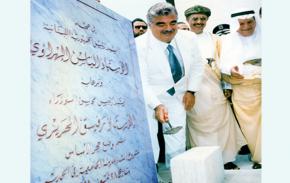
إن اسهامات رفيق الحريري الخيرية والإنمائية لا تحصى، وأبرزها المساعدات المتعددة الأوجه لستة وثلاثين ألف طالب جامعي في جامعات لبنان وخارجه
أنت هنا
GEODESICS : A TOOL IN MANUFACTURING
التبويبات الأساسية
Rached N. ZANTOUT
|
Univ. |
Ohio |
Spec. |
Electrical Engineering |
Deg. |
Year |
#Pages |
|
Ph.D. |
1994 |
165 |
In this dissertation we present geodesics as a viable tool in manufacturing. In chapter II we define geodesics and review their properties. In chapter III the literature is surveyed for methods that already exist to determine geodesics. Almost all of the methods assume that the surface is given analytically. Even when the surface is given analytically, approximation is used to determine a geodesic on that surface. This is due to the difficulty (impossibility in certain cases) to solve the differential equation satisfied by a geodesic on a general surface. To get a close approximation to a geodesic, the surface is searched for curves that satisfy a certain requirement dictated by the characteristics of geodesics.
In chapter III a simple and computationally efficient method is presented to calculate geodesics of a surface. Three cases are treated, a geodesic emanating from a point in a given direction, a geodesic connecting two points and use of interpolation in the previous methods. These methods still calculate approximations to the desired geodesics but are simpler than their continuous counterparts. Simulations are then presented that verify the capabilities of those methods.
In chapter IV an application of geodesics is discussed. In this application, geodesics are used to extract the surface properties of a digitized surface. We review the literature for similar research. The methods range from limiting the surfaces to be recognized to polyhedra, to recognizing sculptured surfaces. A new method is developed to identify the properties of surfaces based on geodesics. The basic idea is that since geodesics capture the intrinsic properties of a surface, they are a good candidate to be used to derive such characteristics.
In chapter V another application of geodesics is discussed. This time geodesics are used to extract the material properties of an object. The object is interrogated for its material properties by deforming it. The advantage of using geodesics here is that the requirement of invasively forming a grid on the object’s surface is alleviated.
In chapter VI we discuss extensions to the research presented in this dissertation. The extensions are mainly to the two areas of application of geodesics in order to make the results applicable in more general cases and more immune to noise. We also suggest new areas in which research can be fruitful.
In chapter VII we conclude this dissertation by reviewing the achievements presented and suggesting further research. The area of surface parameter extraction is rich in ideas for future research that seem promising. The area of material properties extraction is also promising but the ill‑conditioned characteristic of the inverse problem seems as the most difficult step to solve. Other areas where geodesics can be applied are also suggested in the conclusion. The diversity of those areas is proof to the importance of geodesics.