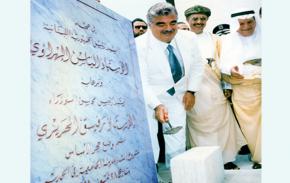
إن اسهامات رفيق الحريري الخيرية والإنمائية لا تحصى، وأبرزها المساعدات المتعددة الأوجه لستة وثلاثين ألف طالب جامعي في جامعات لبنان وخارجه
أنت هنا
THE VALIDATION AND INTERPRETATION OF FIEDLER’S LEAST PREFERRED CO-WORKER SCALE IN LEBANESE SECONDARY SCHOOLS
التبويبات الأساسية
Wahib M. MAHJOUB
|
Univ. |
University of Wales |
Spec. |
Education |
Deg. |
Year |
# Pages |
|
Ph.D |
1986 |
174 |
This is an ex post facto field study conducted throughout Lebanon to test the item-total consistency, the predictive validity, the discriminant validity, and the cognitive complexity interpretation of Fiedler's Least Preferred Co-worker (LPC) scale in Lebanese secondary schools. The results of such study would be useful for cross-cultural purposes, and recommendations were given for future research in a centralized educational system such as that of Lebanon.
A multi-stage sampling procedure was followed to select a representative sample of private and public secondary schools in all of Lebanon. Selection criteria included:
1. Principals with at least one or more years of administrative experience at their schools,
2. Representation of all regions in the country, and
3. Each selected school has in its employment at least thirty-two teachers to assure organizational complexity.
In this study, therefore, the population sample consisted of 98 principals, 656 teachers who taught the third secondary class, and 2375 students representing the third secondary classes in all 98 schools.
Fiedler's (1976) LPC scale was used to assess the principals’ leadership styles, and was administered to the participating principals twice, with an interval of two months, in order to have evidence of its reliability. Smith et al.(1975) Job Description index was administered to the participating teachers in order to assess teachers' satisfaction at their job. The Lebanese Baccalaureate Part II Examinations for the academic year 1984 were used to assess the achievement outcomes of the students of all participating schools. The three instruments were used in collecting data.
Product-Moment correlation, t-test and X2 (chi-square) techniques were involved in the data analysis.
The results show:
- The LPC scale has an acceptable test-retest reliability.
- There is item-total consistency between LPC scores and judgments expressed by the Lebanese principals.
- Seventeen items of the LPC scale have discriminatory power at the one percent level and above.
- One item of the LPC scale needs to be refined.
- The LPC scale is a useful predictor of a principal's effectiveness in Lebanese secondary schools if a principal's LPC score interacts with his/her years of administrative experience.
- The principal's LPC is a measure of cognitive complexity.
- The LPC scale measures dimensional discrimination.
- Principals who differ on total LPC score also differ in terms of underlying dimensions of the LPC scale.
- High-LPC and low-LPC principals differ in terms of cognitive structure.
- High-LPC principals employ more dimensions, make finer discrimination and, therefore, employ more categories when evaluating their least preferred co-workers, and hence are more cognitively complex than low-LPC principals.
- High-LPC principals tend to describe their least preferred coworkers in positive terms, while low-LPC principals tend to describe their least preferred co-workers in negative terms.