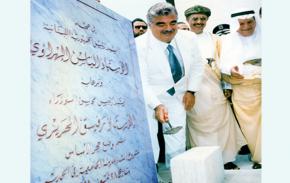
إن اسهامات رفيق الحريري الخيرية والإنمائية لا تحصى، وأبرزها المساعدات المتعددة الأوجه لستة وثلاثين ألف طالب جامعي في جامعات لبنان وخارجه
أنت هنا
MODELING MULTICOMPONENT GAS TRANSPORT IN POROUS MEDIA
التبويبات الأساسية
Mohamad A. HINDAWI
|
Univ. |
Tulane |
Spec. |
Chemical Engineering |
Deg. |
Year |
#Pages |
|
Ph.D. |
1994 |
144 |
Complex models are developed for a three component system that deals with diffusion of gaseous reactants and products in porous media. These models are applied to a specific chemical process that removes metal oxides from porous media. Model predictions results were compared to the experimental results.
A general analytical solutions to be derived. Assuming that the gases are ideal for all models (thin film, dusty gas, and a combination of both models). These solutions allow the calculation of fluxes.
The transient state case for both models (the thin film model and the dusty gas model) is solved. The concentration profiles of diffusing gases rapidly approach the steady state. The reaction time is conducted in hours while the time needed to reach the steady state is in order of several minutes; therefore no further consideration was given to the transient state.
In the dusty gas model, the flux increases as the pore radius and the reaction temperature increase. A feature common to all of these results is the linearity between the flux and the gas temperature for different values of pore radii. However, as the pore radius becomes large the dusty gas model reduces to the thin film model.
Solutions are developed for a complex model which involves a combination of a thin film and a cylindrical pore in series. The model showed that the effect of the film thickness is negligible when it is comparable to the pore length.
The prediction of metal removal based upon the dusty gas model, which is applied to parallel cylindrical pores, is in excellent agreement with the experimental results of the metal removal. The geometry of the parallel pores is determined by the BJH method.