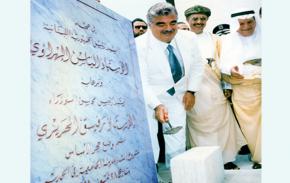
إن اسهامات رفيق الحريري الخيرية والإنمائية لا تحصى، وأبرزها المساعدات المتعددة الأوجه لستة وثلاثين ألف طالب جامعي في جامعات لبنان وخارجه
أنت هنا
LEARNING CONTROL CONVERGENCE AND ROBUSTNESS
التبويبات الأساسية
Samer S. SAAB
|
Univ. |
Pittsburgh |
Spec. |
Electrical Engineering |
Deg. |
Year |
Pages |
|
Ph.D. |
1992 |
160 |
To date most of the available results in learning control have been utilized in applications where a robot is required to execute the same motion over and over again, with a certain periodicity. This is due to the requirement that all learning algorithms assume that a desired output is given a priori over the time duration t Є [0,T]. For applications where the desired outputs are assumed to change "slowly", two sets of lear3ning algorithms are presented. One set employs on line measurements of the current desired trajectories and the other uses measurements of the previous desired trajectories. At each iteration we assume that the system outputs and desired trajectories are contaminated with measurement noise, the system state contains disturbances and erro are present during reinitialization. These algorithms are shown to be robust and convergent under certain conditions.
Learning algorithms require measurements of the output. e.g., angular velocity of the joints in robotic systems. Since measured signals are typically contaminated by noise, differentiation tends to amplify the noise. This work investigates the robustness and convergence of the P type learning control algorithms for a class of time varying, nonlinear systems subject to state disturbances, measurement noise, and reinitialization errors at each iteration. It is shown that if certain conditions are met, then the robustness and convergence of the P type algorithms are assured.
An auxiliary method is proposed to alleviate the difficulty of determining a priori the controller parameters such that the speed of convergence is improved. Moreover, a numerical example is given showing that the application of the proposed results is optimum in some sense.
Implication of our results to a robot manipulator is given in detail, and several examples are given throughout this dissertation to illustrate the results.