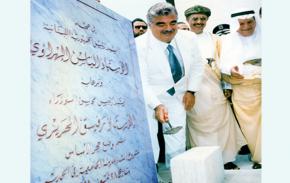
إن اسهامات رفيق الحريري الخيرية والإنمائية لا تحصى، وأبرزها المساعدات المتعددة الأوجه لستة وثلاثين ألف طالب جامعي في جامعات لبنان وخارجه
أنت هنا
APPLICATION OF ARTIFICIAL INTELLIGENCE TO THE SECURITY ASSESSMENT OF ELECTRICAL POWER SYSTEMS
التبويبات الأساسية
Ali S. MAOUCHE
|
Univ. |
London |
Spec. |
Electronic Engineering |
Deg. |
Year |
#Pages |
|
Ph.D. |
1992 |
198 |
Artificial Intelligence (AI) is applied to the problem of screening electricity distribution networks for insecure operating states. The aim of this work has been to develop an expert system (ES) to assist in the task of security evaluation in a control-room environment. The system must be able to carry out the same kinds of task as the human specialist, and should operate very fast.
Various novel analytical methods have been developed by the Author to evaluate the security of electrical power systems, with particular emphasis on the use of expert systems and their integration with existing algorithmic software.
The expert system acts as an interface between the control engineer and the analytical procedures. Furthermore it gives guidance to determine control actions concerned with the necessary reactive compensation during post-outage conditions. It can also assist with reactive power planning functions such as location and sizing of capacitors and tap adjustment of transformers for voltage control.
After a brief review of the field, expert systems are presented in general terms. This presentation includes the most popular tools including AI languages such PROLOG and LISP, knowledge representation techniques and inference mechanisms.
Following an explanation of the lesser known SE graph representation of power systems, novel extensions of the method for calculation of contingency and voltage control are presented.
A new group security approach for fast evaluation of overload problems under emergency conditions is also developed in this work and it is shown to be very efficient and reasonably accurate for on-line applications.
These new procedures are integrated with an expert system that controls all programs for security assessment. The overall computational system is discussed in detail.
The IEEE 30-bus power system is used to demonstrate this approach. Results of various tests are presented and discussed and conclusions are drawn about the use of expert systems technology in this application. Further improvements, and topics for further development are suggested.