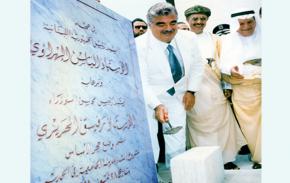
إن اسهامات رفيق الحريري الخيرية والإنمائية لا تحصى، وأبرزها المساعدات المتعددة الأوجه لستة وثلاثين ألف طالب جامعي في جامعات لبنان وخارجه
أنت هنا
Moment Coefficients for Ribbed Slabs with Solid Slab Strip Support
التبويبات الأساسية
Walid Y. MAHMOUD
|
Univ. |
Leeds |
Spec. |
Civil Engineering |
Deg./Ph.D. |
Year 1984 |
# Pages/295 |
The main objective of the studies reported in this thesis is to develop means by which reinforced concrete floor systems composed of waffle slabs with solid slab strip support could be analyzed and designed. The approach to this problem has been made through elastic analyses of internal, edge and corner panels subject to uniform transverse load, considering primarily the influence of solid strip width variations. The analyses were carried out using a finite element package (LEAP5). A large number of the variables influencing the structural response of the slab, particularly the distribution of bending moments within the panel, were examined with a view to producing sufficient information for design purposes.
The theoretical behavior of solid and fully ribbed flat slabs has also been considered and compared to the requirements of the codes of practice. The possibility that the behavior of a fully ribbed slab contradicts the assumptions of the codes is noted. The effects of solid regions around the columns in a waffle slab is described and compared to that of drop panels as anticipated by the codes. The results of these analyses were then brought together with those derived for waffle slabs supported on solid strips for comparison purposes. The study reveals many structural advantages of the latter, particularly in structures demanding longer spans and/or heavier loads.
The simplified design method proposed for waffle slabs with solid strips gives full information on the moment field throughout the panel. The number of parameters for which moment coefficients are given is extensive enough to cater for most of the practical situations. Moreover, since an elastic analysis has been used in deriving the suggested approach, a better control of serviceability will probably be achieved.
The bending moment and deflection results from laboratory tests on a small scale waffle slab model for different boundary conditions and different solid strip width to panel span ratios are presented and compared with the theoretical values.
The suitability of the strip method for the design of this type of waffle slabs is discussed. The strip method results for internal panels are compared with the simplified method.
Finally, an attempt has been made to determine elastic twistless solutions in waffle slabs supported on downstand strip beams.