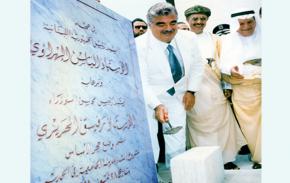
إن اسهامات رفيق الحريري الخيرية والإنمائية لا تحصى، وأبرزها المساعدات المتعددة الأوجه لستة وثلاثين ألف طالب جامعي في جامعات لبنان وخارجه
أنت هنا
A Theoretical and Experimental Study of Dynamic Consolidation Technique
التبويبات الأساسية
Nizar A.R. GHAZIREH
|
Univ. |
Birmingham |
Spec. |
Civil Engineering |
Deg./Ph.D. |
Year 1991 |
# Pages/218 |
This thesis briefly summarizes the various methods of ground improvement and then concentrates on the dynamic compaction technique. The history of the method is summarized and a review of the previous experimental and theoretical work is given.
A simple theoretical study was carried out and an analytical equation was derived in order to predict the dynamic load on the soil surface. A computer program was written in order to calculate the stresses and deformations in the soil when subjected to impact loads. The calculation of stresses and deformations was based onBoussinesq theory.
Also the thesis investigates the behavior of fully saturated sandy soils subjected to dynamic loading and examines the effects of falling mass, drop height and confining pressure on the loads, stresses, excess pore water pressure and both the dynamic and permanent displacements. Over 30 tests were carried out on specimens of 100 mmdiameter and 200 mm height, which were prepared in the laboratory. The falling masses ranged from 1 kg to 6 kf , the falling heights varied from 100 mm to 800 mm and the confining pressure ranged from 50 kPa to 300 kPa.
The variation of porosity with the number of blows was studied. In addition, by carrying out a set of dynamic‑static triaxial tests, the effect of compaction on the angle of shearing resistance was investigated. In these tests each specimen was firstconpacted to the desired level under certain conditions, and then it was tested in drained conditions to evaluate ø'.
A statistical analysis was carried out on the results obtained by the experimental work in order to find statistical models representing the variation of dynamic load, dynamic stress, dynamic p.w.p and both dynamic and permanent displacements.
The variation of loads, stresses, p.w.p and displacements with time at the instant of impact was also studied. It was found that at impact a stress wave is created at the contact surface. This stress wave is reflected at the base and superposed with the original stress wave. This superposition dies with time.