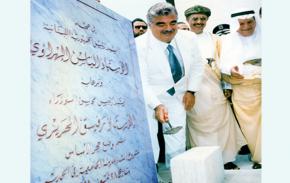
إن اسهامات رفيق الحريري الخيرية والإنمائية لا تحصى، وأبرزها المساعدات المتعددة الأوجه لستة وثلاثين ألف طالب جامعي في جامعات لبنان وخارجه
أنت هنا
Structural Evaluation of Thinly-Surfaced Granular Pavements
التبويبات الأساسية
Hani A.R. FADDAOUI
|
Univ. |
Loughborough |
Spec. |
Civil Engineering |
Deg./Ph.D. |
Year 1992 |
# Pages/126 |
The aim of this research program was to develop a pavement evaluation procedure for thinly surfaced dressed granular pavements.
Although well advanced and rational pavement evaluation techniques for bituminous pavements are now being introduced, pavement evaluation procedures adopted for overseas roads are still largely based on empirical data and pavement strength is related to the maximum transient deflection of the pavement under a standard wheel load. The maximum transient deflection is merely a general indicator of the pavement performance and incapable of identifying the weaknesses, whether they are due to the pavement layers or its foundation.
Theoretical studies were conducted on two and three layered thinly surfaced pavements to investigate the effect of varying the thickness and stiffness of the pavement layers on the transient deflection basin and its radius of curvature under the application of a standard wheel load. The maximum transient deflection was found to be controlled by both the base layer and subgrade. The radius of curvature was mainly related to the stiffness of the base layer. The interrelationship between the maximum transient deflection, radius of curvature, and their product showed to be useful in detecting changes in the condition of the pavement layers and its foundation.
Experimental investigation was carried out to verify the theoretical predictions. A number of surfaced dressed, unbound pavement structures were assessed under repeated standard axle loads in a 3.8 m. square by 1.3 m deep pit. The structures consisted of variable thickness of sand and gravel and crushed limestone bases constructed over a Keuper Marl subgrade. Transient deflections, to define the deflected shape of the pavement surface, permanent surface deformation and radius of curvature were measured. Well-defined and consistent patterns of the various performance indicators were found, with good correlation between the radius of curvature measured by a curvature meter, and Surface Curvature Index. The technique of using a combination of the trends of the maximum transient deflection, radius of curvature, and their product in detecting weaknesses in the individual layer and the subgrade was generally found to correlate reasonably well with the theoretical predictions as well as with the pavement deflection basin indices.
The layered pavement systems used in the testing pit were modeled with a multi‑layered linear elastic computer program, and the insitu stiffness of the individual layers was backcalculated. The maximum transient deflection, radius of curvature and their product were found to be in a reasonable agreement with the backcalculatedstiffness. Laboratory triaxial repeated loading tests were carried out on remolded,recompactedKeuper Marl samples conditioned to represent the insitusubgrade during each test. The derived values of the subgrade stiffness were compared with thebackcalculated ones and it was found that undisturbed sampling of the subgrade from the test pit was necessary conditions of the to gain reliable data.