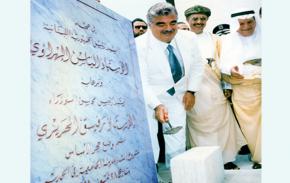
إن اسهامات رفيق الحريري الخيرية والإنمائية لا تحصى، وأبرزها المساعدات المتعددة الأوجه لستة وثلاثين ألف طالب جامعي في جامعات لبنان وخارجه
أنت هنا
Motion Based Design Methodology for Buildings
التبويبات الأساسية
Boutros S. ABBOUD KLINK
|
Univ. |
M.I.T. |
Spec. |
Civil Engineering |
Deg./D.Sc. |
Year 1995 |
# Pages/366 |
Current preliminary design methodologies for buildings are primarily strength‑based. Such methods are adequate when strength is expected to govern the design. But as the slenderness of structures increases, motion becomes the dominant criterion and strength‑based design methods become deficient. In this thesis, a preliminary design approach for structures where motion dominates the design, capable of supporting the simultaneous satisfaction of multiple performance objectives as well as the selection and deployment of motion control mechanisms in structures is proposed. Specifically, methods for distributing energy storage, energy absorption, and energy dissipation elements along the height of building structures are developed to yield bounded maximum deformation profiles when the buildings are subjected to seismic excitation.
The thesis is divided into five parts.
Part I develops an analytical solution for distributing stiffness in buildings (modeled as cantilever beams) such that the fundamental mode is characterized by a bounded uniform deformation profile. An iterative scheme is proposed to account for the effect of the higher modes.
Part II evaluates the effect of damping and presents methodologies for distributing viscous and hysteretic (characterized by an elastic/perfectly plastic force‑deformation behavior) damping in structures.
Part III evaluates the effectiveness of tuned mass damper systems for seismic excitations.
Part IV deals with base isolation systems and a method for distributing stiffness in low‑rise base isolated structures to achieve a bounded quasi‑uniform maximum deformation profile is proposed. The trade‑off between damping in the structure and damping in the isolation system is also addressed.
Finally, Part V evaluates active control as a method for controlling structural deformations, emphasizing the levels of control force, power, and energy required. Three active control algorithms for reducing the effect of higher modes are proposed, and the detrimental effect of time delay is assessed. Cantilever beam examples covering a range of aspect ratios accompany the development to evaluate the effectiveness of the proposed motion‑based design schemes.