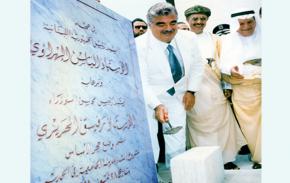
إن اسهامات رفيق الحريري الخيرية والإنمائية لا تحصى، وأبرزها المساعدات المتعددة الأوجه لستة وثلاثين ألف طالب جامعي في جامعات لبنان وخارجه
أنت هنا
KNOWLEDGE-BASED CONTINGENCY ANALYSIS FOR STEADY-STATE STABILITY OF POWER SYSTEMS USING A GRAPHICAL USER INTERFACE AND DATA VISUALIZATION ASSEMBLAGE
التبويبات الأساسية
Mohammad R. KHALDI
|
Univ. |
The Pennsylvania State University |
Spec. |
Electrical Engineering |
Deg. |
Year |
# Pages |
|
Ph.D. |
1995 |
205 |
In large-scale power systems, numerous generating plants provide energy to hundreds of thousands of power hungry consumers through exceedingly flexible and dynamic networks of transmission lines. The delivered electrical energy is maintained in high quality and the voltage profile is kept within acceptable limits by the utilization of thousands of control devices scattered in key location over the power grid. Thus, one of the most important problems facing power utilities is to coordinate the reactive power compensation devices to maintain acceptable bus voltage profile while minimizing operational costs and assuring system stability in the presence of small disturbances. In practice, the dispatcher, traditionally a trained human expert, makes the decision as to the location, the switching sequence, and the amount of compensation needed of the control devices. To aid with this sometimes overwhelming decision-making task an intelligent knowledge-based contingency analysis for steady-state stability and voltage control is developed using graphical user interface and data visualization. Moreover, the developed expert systems rely on the sensitivity of the load bus voltage profile due to differential changes in the compensating devices to infer a solution to alleviate the voltage problem. To this end. a novel vectorized approach for power systems models and the corresponding sensitivity matrices are introduced.
Computer application in power systems analysis is unavoidable. Voltage profile, as an example, can only be determined by a numerical approach. Both operation and planning use computers extensively to analyze and simulate power systems. Computers are also used to monitor, analyze, and control power systems both on-line and off-line. The Power Systems Analysis Toolbox (PSAT) developed in this dissertation is a Graphical User Interface (GUI) Object-
Oriented MATLAB-based developmental software package which is primarily used for education. operator training, simulation and control using contingency analysis, data visualization, and Knowledge-Based Systems paradigms.